
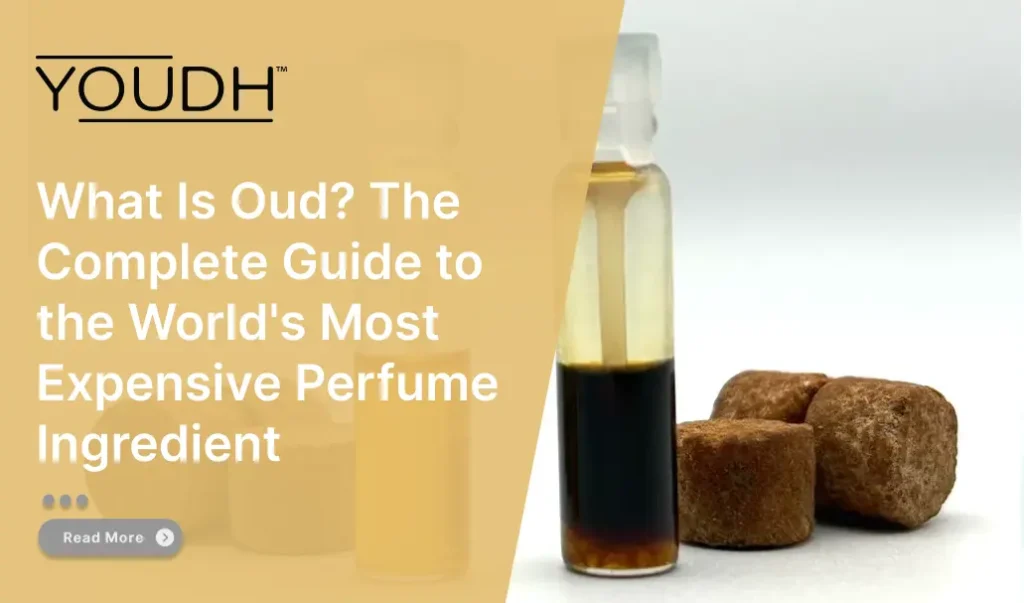
What is oud? In one sentence, oud is the dark, fragrant resin produced inside the Aquilaria tree when it becomes infected by a specific mould, along with the resinous wood (agarwood) and the oil distilled from it (oud oil). What is oud worth? By weight, real oud oil is regularly more valuable than gold. What is oud’s history? Over a thousand years of continuous use across the Arabian Peninsula, South Asia, and Southeast Asia.
If you have ever asked what is oud, what is oud oil, or what is oud actually made from, this guide is the complete picture. We cover what oud is, where oud comes from, how oud is made, what oud smells like, the cultural significance of oud, the different forms oud takes, and why oud is so expensive. By the end, you will know exactly what oud is and how to choose the right oud for you.
Oud is the dark, fragrant resin produced inside the heartwood of the Aquilaria tree. When the tree is wounded and a specific species of mould enters the wound, the Aquilaria tree responds by producing resin as a natural defence. Over years, sometimes decades, the resin saturates the heartwood, turning the pale wood dark, dense, and intensely fragrant. That resin-rich wood is called agarwood, and the oil distilled from it is what we know as oud oil.
So what is oud at its core? Oud is three connected things: the resin itself, the agarwood that contains it, and the oud oil distilled from that agarwood. The word oud comes from the Arabic عود (“ʻud”), meaning wood or stick. Oud has been traded as a fragrance material since at least the ninth century, with references appearing in religious texts, classical Arabic poetry, and ancient Sanskrit literature. Oud is also called agarwood, aloeswood, or eaglewood depending on the region and language.
Three things make oud different from every other perfume ingredient. Oud is biologically rare, because only a small percentage of wild Aquilaria trees ever produce usable resin. Oud is chemically complex, because the resin contains hundreds of aromatic compounds that cannot be replicated synthetically. And oud is culturally meaningful, with deep roots in religious, social, and hospitality traditions across vast parts of the world.
All real oud comes from trees in the Aquilaria genus, found across South and Southeast Asia. So what is oud sourced from in practice? The three most commercially significant species used for oud are Aquilaria malaccensis, Aquilaria crassna, and Aquilaria sinensis.
Aquilaria malaccensis grows across India, Bangladesh, Bhutan, Myanmar, Malaysia, and Indonesia. It is the species behind classical Indian oud and is also one of the most heavily protected, as wild populations have declined sharply over the last century. The species is listed on CITES Appendix II, the international agreement controlling trade in vulnerable species.
Aquilaria crassna is the main species in Cambodia, Vietnam, Thailand, and Laos. This is the source of most Cambodian and Vietnamese oud, known for its sweeter, more balsamic oud scent. Aquilaria sinensis grows mainly in southern China and Hainan, and produces some of the most refined and balanced oud in the world.
The Aquilaria tree grows tall and straight, with pale, unscented wood. The transformation into oud only begins when the tree is wounded and infected. In the wild, this happens by chance: a broken branch, an insect bore, lightning damage. The tree’s defence response is what produces the resin, and the resin is what eventually becomes oud.
Understanding what oud is in raw form is one thing. Understanding how oud is processed into oud oil explains both the price and the depth of the scent. Real oud production is slow, biological, and almost impossible to industrialise.
Oud cannot form in a healthy Aquilaria tree. The wood needs to be wounded, and a specific mould, often Phaeoacremonium, needs to enter the wound. The tree then produces dark, aromatic resin to seal off the infected tissue. This process takes years. Fewer than two in every hundred wild Aquilaria trees produce enough resin naturally to be commercially useful, which is the single biggest reason oud is so rare. Today, sustainable plantations also use controlled inoculation to encourage resin production in cultivated Aquilaria, which reduces pressure on wild trees.
Once an Aquilaria tree has developed enough resin-rich heartwood, it is harvested. The dark, resinous agarwood is carefully separated from the pale, unscented outer wood by hand. Higher resin content means higher quality, and the very best agarwood sinks in water because of how saturated it is with resin. This is where the term sinking agarwood comes from, used in the trade to describe the finest grades.
The agarwood is broken into chips or ground into powder and soaked in water for days or weeks. This breaks down the wood fibres and helps release the resin. The soaked wood is then steam-distilled in copper stills, often for several days at a time. The oud oil that emerges is dark, viscous, and intensely fragrant. The yield is tiny. Many kilograms of agarwood are needed to produce a few millilitres of pure oud oil.
Fresh oud oil straight from the still can smell sharp, smoky, or animalic. Like a fine wine, oud oil matures over time. Most quality oud oil is aged for months or years before it is bottled. Aging softens the rough edges of the oud and lets the deeper, warmer, more balsamic notes come forward.
If what is oud is the first question, what does oud smell like is almost always the second. The oud smell is unlike any other natural material in perfumery. A typical oud scent combines four overlapping layers: woody, balsamic, smoky, and animalic.
Woody is the foundation. Think aged, polished hardwood, dense and dry rather than fresh or green. Balsamic is the resinous warmth underneath the wood, slightly sweet and rounded, like warm amber or labdanum. Smoky is the soft incense-like quality that rises through the wood, never harsh, often meditative. Animalic is the leathery, slightly funky warmth that marks oud as a living natural material rather than a synthetic accord.
The exact balance depends on where the oud came from. Indian oud is dark, dense, and openly animalic. Cambodian oud is honeyed, fruity, and softer. Vietnamese oud is smoky and incense-like. Malaysian oud is fresher and slightly green. We cover these regional differences in detail in our companion oud scent guide.
What is oud worth in practice? Real oud is one of the most expensive raw materials in perfumery, often more valuable by weight than gold. The price of oud comes from several compounding factors.
First, biological rarity. Only a small percentage of wild Aquilaria trees develop the fungal infection that produces oud-bearing resin, and the resin takes years or decades to form. Second, slow and labour-intensive production. Harvesting agarwood is done by hand, the soaking and distillation process takes days, and the final yield is tiny relative to the input. Third, regulatory protection. The Aquilaria tree is CITES-protected, which adds export controls, paperwork, and compliance costs throughout the supply chain. Fourth, aging. The best oud oil is matured for years before it is bottled, which ties up capital and adds to the final cost.
Synthetic oud accords exist precisely because real oud is so expensive. They imitate the warm, woody facets of the oud smell at a fraction of the cost, but they cannot reproduce the depth, complexity, or evolution of natural oud oil.
What is oud to the cultures that have used it longest? Oud is not just a fragrance ingredient. Oud is a cultural touchstone across some of the oldest perfumery traditions in the world.
Oud holds a special place in Islamic tradition, following the Quran and Sunnah. The Prophet Muhammad (peace be upon him) is reported to have used oud, and the use of oud and bakhoor is a long-standing practice in many Muslim households. Fragrance is applied before prayer, oud is burned at gatherings, and offering oud or bakhoor to guests is considered a mark of generous hospitality.
In the Gulf states, oud is woven into everyday life. Homes are scented with bakhoor before guests arrive. Oud is given as a gift at weddings, Eid, and important family occasions. The use of oud in personal fragrance is considered a sign of refinement, and the depth of someone’s oud knowledge is often a quiet marker of cultural literacy.
In India, agarwood has been part of Ayurveda and traditional medicine for centuries, in addition to its role in perfumery. In Buddhist traditions across Southeast Asia, agarwood is burned as incense for meditation and temple ceremonies. The cultural significance of oud predates modern perfumery by over a thousand years.
Once you know what oud is, the next practical question is what form to buy oud in. Oud is sold and used in several distinct forms, and each delivers the oud scent in a different way.
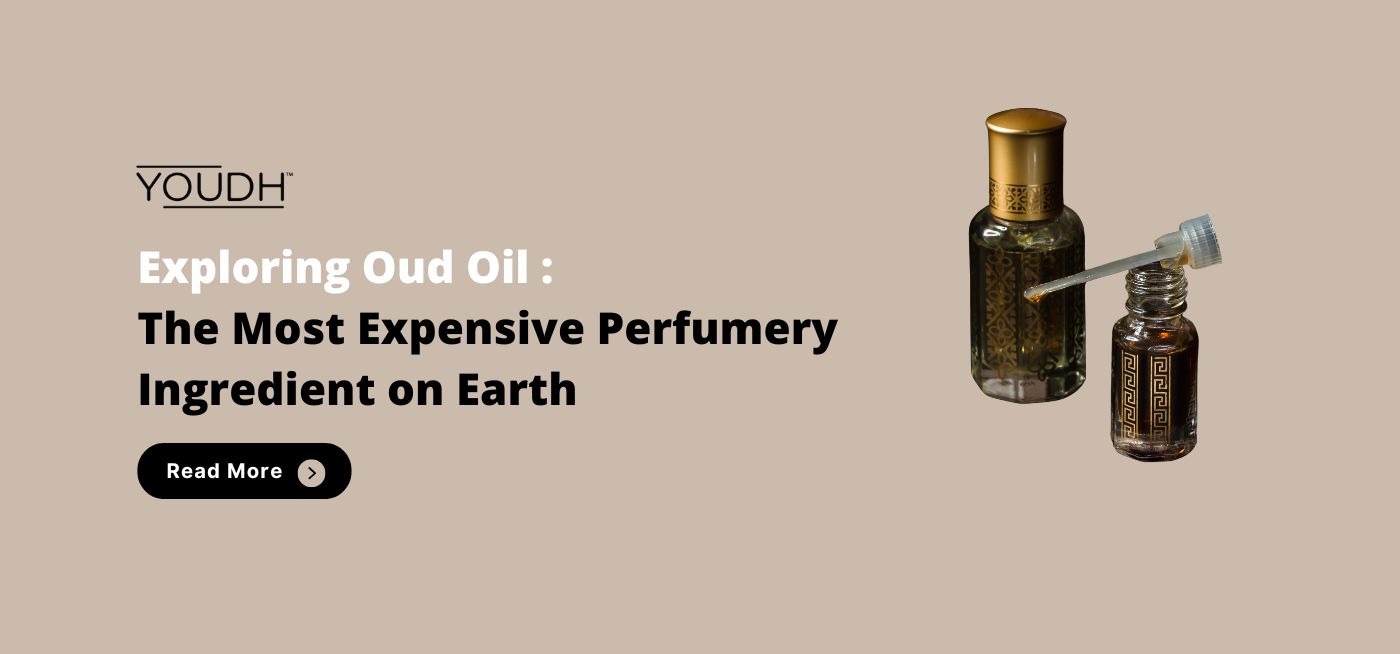
Oud oil is the most concentrated form: pure distilled oud applied as a perfume oil. It is dark, viscous, and intensely fragrant. A single drop is enough for the full day. This is the format used in traditional Arabian and South Asian perfumery and the heart of the YOUDH range.
Most Western fragrance houses use oud as a note within an alcohol-based eau de parfum spray. These can be beautiful, but the alcohol carrier evaporates quickly, flattening the slow evolution of natural oud and shortening the wear.
Bakhoor is wood chips or paste soaked in oud oil and other aromatic ingredients, burned slowly over hot charcoal. This is the traditional way oud is used to scent homes, clothes, and gatherings across the Gulf. Pure agarwood chips can also be burned directly as incense.
Raw agarwood chips are sold for direct burning. The chips release a clean, woody, slightly smoky oud scent when warmed. This is the most traditional way oud has been experienced for over a thousand years.
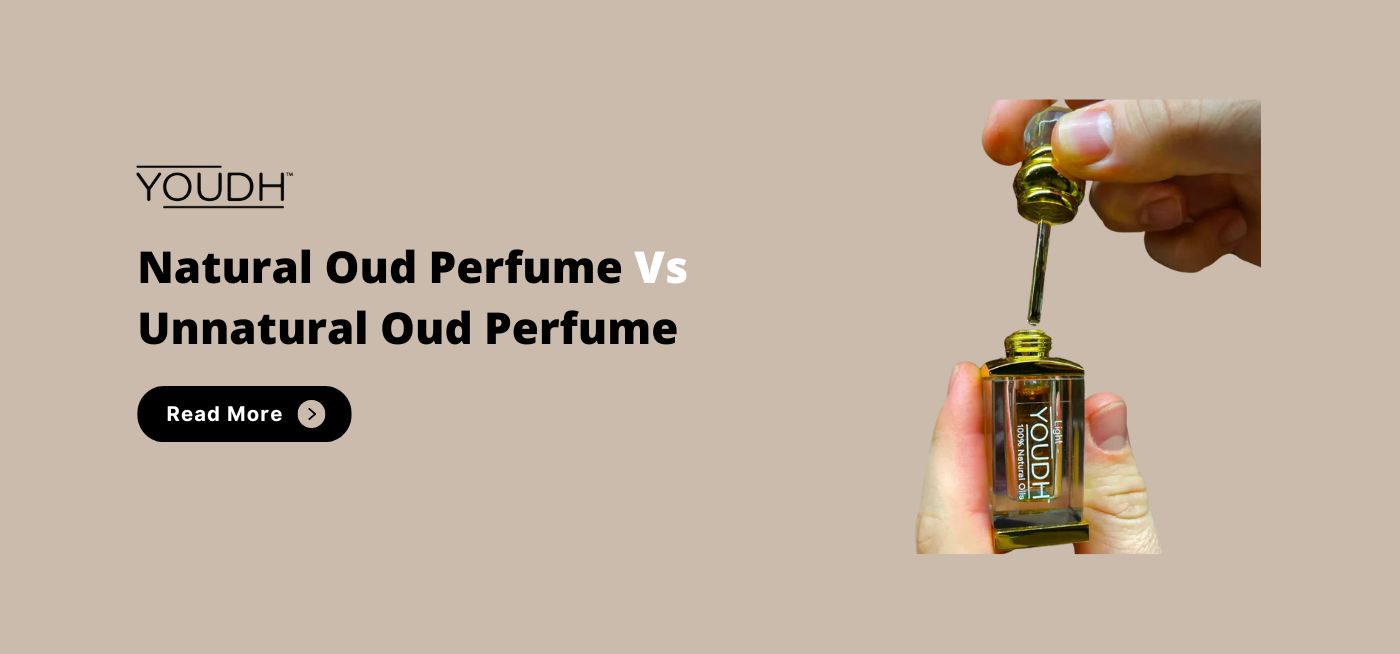
Most high-street fragrances labelled as oud contain little or no real oud. They rely on synthetic oud accords: lab-made molecules that imitate the warm, woody facets of the oud smell. Synthetic oud is linear, sits on top of the skin, and does not evolve. It is also cheap to produce, which is why so many products marketed as oud have very little real oud in them.
Natural oud oil behaves differently. Real oud is biologically complex, evolves over hours on the skin, and reacts to the wearer’s body chemistry. Two people wearing the same natural oud will smell slightly different, because the oud scent forms a quiet conversation with the skin. This is the experience oud has offered for centuries and the one that synthetic copies cannot deliver.
Oud can feel intimidating for newcomers, but choosing your first oud is simpler than it looks. The most important question is whether you prefer a lighter, brighter fragrance or a deeper, smoky oud.
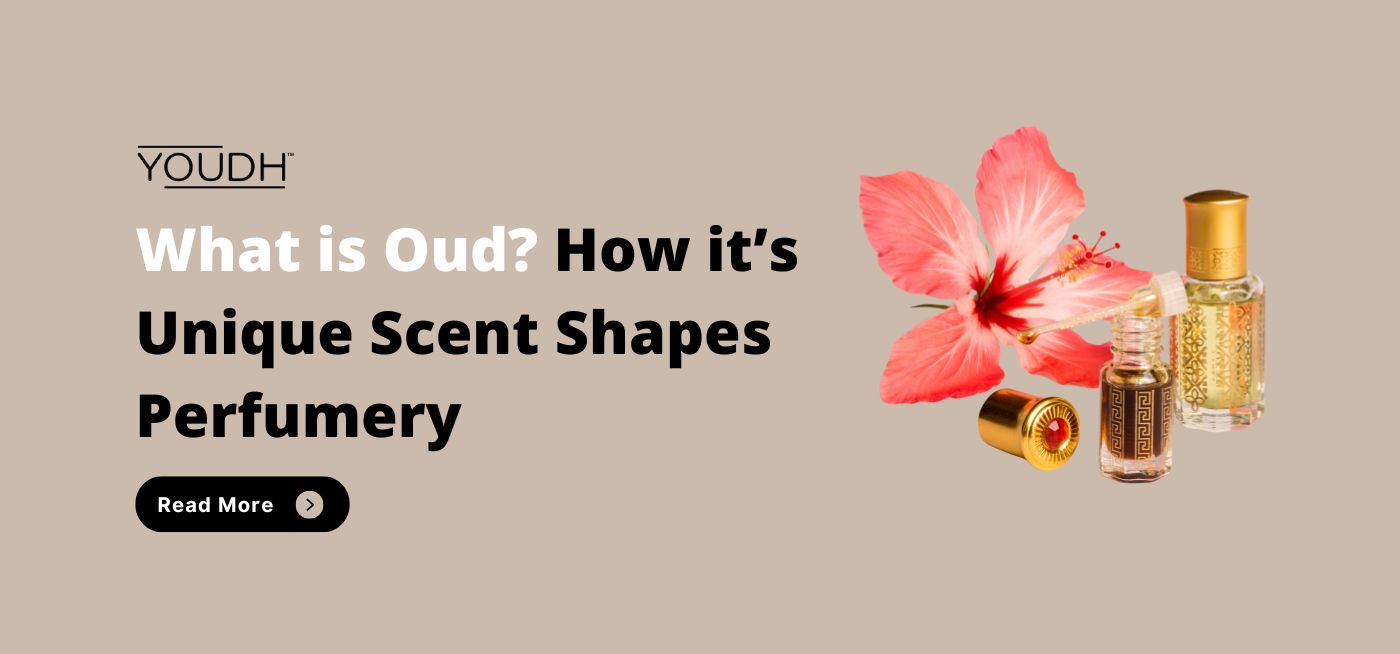
If you want an easier introduction to oud, start with a blended oud paired with rose, vanilla, citrus, or sandalwood. The oud is present and grounding, but softened by lighter notes that make it more wearable for everyday life. This is where most UK newcomers start.
If you already love deep, woody, smoky fragrance, go straight to a darker oud blend or pure oud oil. The full traditional oud experience is intense, complex, and unmistakable.
YOUDH is a UK-based fragrance house focused on natural oud crafted for everyday wear. Our oud is 100% natural, alcohol-free, hypoallergenic, and made without phthalates, hormone disruptors, or synthetic fillers. Every bottle is built around real oud oil, distilled from ethically sourced agarwood and crafted in the UK.
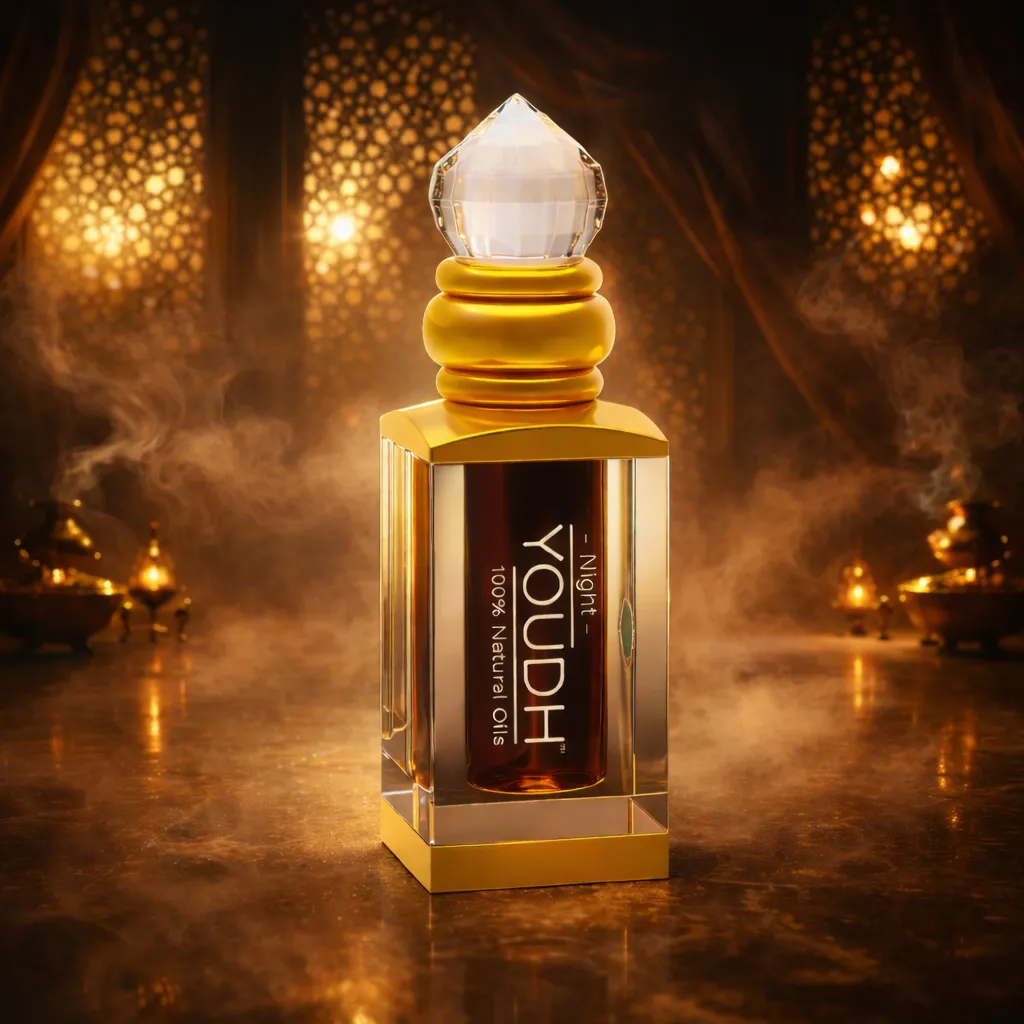
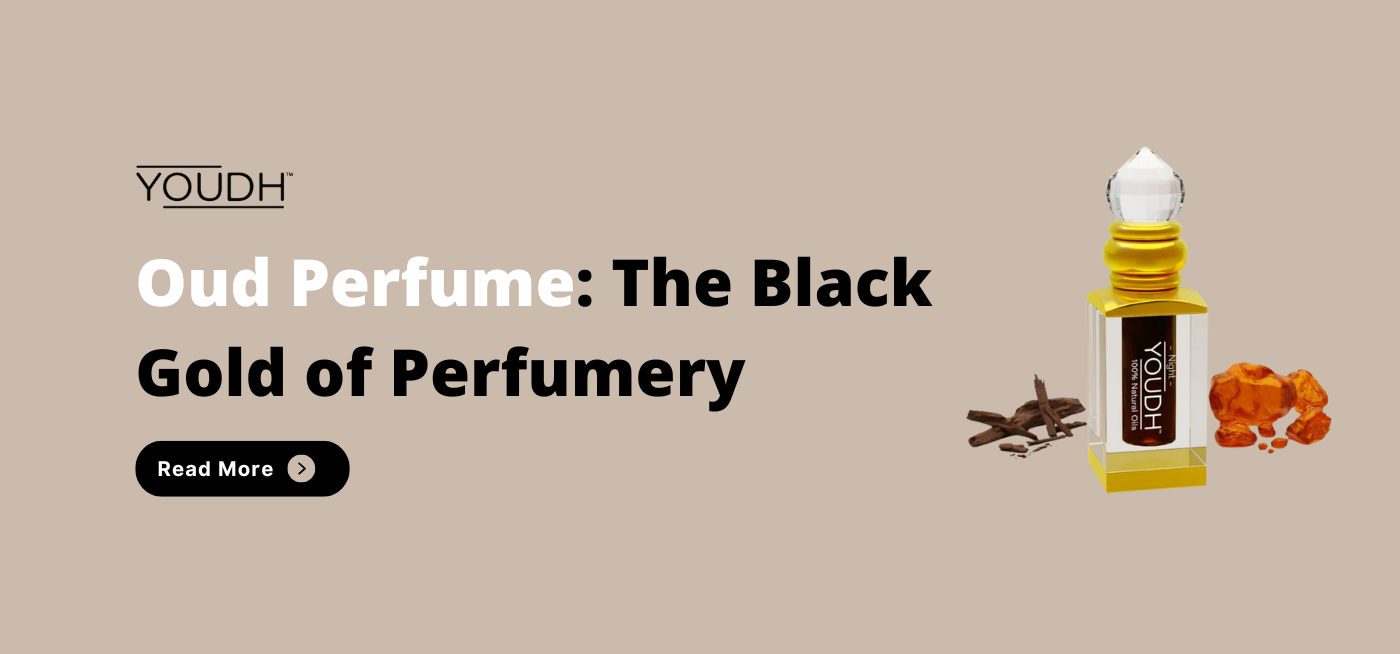
YOUDH Light is the brighter, softer side of oud. The natural oud oil is paired with citrus, vanilla, and floral notes to create a warm but lifted fragrance, easy to wear for someone trying oud for the first time. YOUDH Night is the deeper, more traditional oud, with smoke, musk, and resin shaping the trail. Both come as 3ml oils that last daily wearers around three months, because real oud only needs a drop.
Oud has been worn for over a thousand years because the experience is unlike anything else. A drop of real oud oil in the morning gives you a full day of warm, evolving, deeply personal fragrance, without alcohol, without synthetic additives, and without the irritation many modern perfumes cause. If you have been curious about what oud is and how it actually wears, YOUDH was built for exactly this moment.
Explore the YOUDH range and discover natural oud crafted for the UK. For a closer look at the source, read our companion guides on oud oil and what oud smells like. Free UK delivery on orders over £50.
Rose oud perfume is the pairing of two of perfumery’s most powerful natural materials: the deep, resinous warmth of oud and the fresh, layered sweetness of rose. It is one of the oldest and…
You spray a designer oud, catch a rich opening, and by lunchtime it has all but vanished. That fade is not bad luck. It is chemistry. Most oud you buy on the high street is an oud perfume: a small…
What Is Attar? The Complete Guide to Traditional Perfume Oil Attar is one of the oldest continuously used perfume traditions in the world. For over a thousand years, attar has been the foundation of…
Walk into any traditional perfume shop in the Gulf and you will find rows of small bottles labelled mukhallat. The word covers a category of fragrance that has shaped Arab perfumery for centuries,…
You light your first oud incense cone, expect a deep warm scent to fill the room, and instead get a sharp synthetic smoke that fades in ten minutes. The problem is not your technique. Most so-called…
Oud wood is the rarest fragrant wood in the world. A single kilogram can cost more than gold. Agarwood has been burned in homes across the Middle East, India, and Southeast Asia for over a thousand…
Can females wear oud? The short answer is yes, absolutely, and they have been doing so for over a thousand years. Can females wear oud the same way men do? Yes, with the same application techniques…
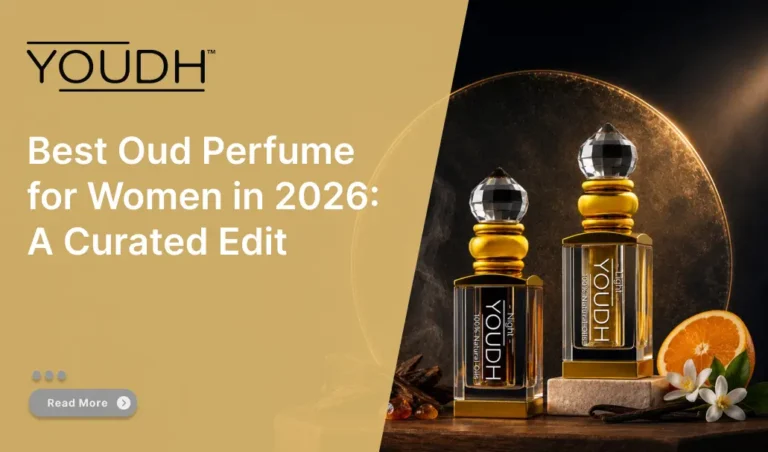
The best oud perfume for women has nothing to do with whether oud is masculine or feminine. Oud has been worn by women across the Middle East, South Asia, and North Africa for over a thousand years,…
Oud is the most powerful fragrance in a man’s collection, and the most easily wasted. Apply oud for men the wrong way and you get a fragrance that fades by lunch, projects too loudly, or never…