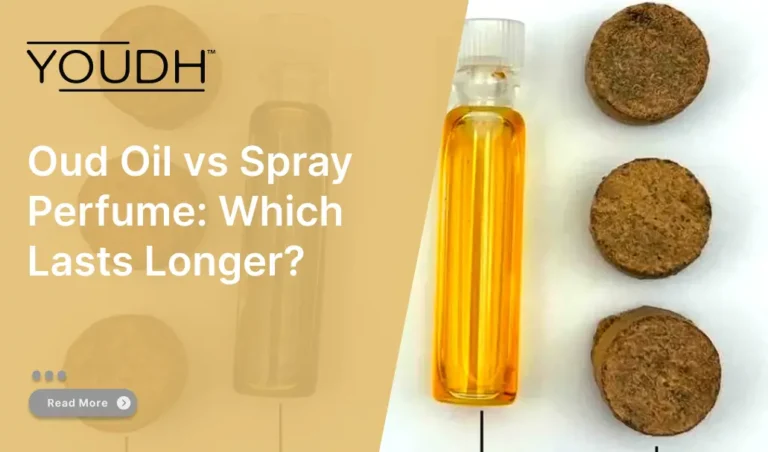

Oud oil generally lasts longer on skin than an alcohol-based spray, often six to ten hours compared with four to six. That comes down to one thing: oil evaporates far more slowly than alcohol. Sprays win on projection and that first noticeable burst of scent, so which is “better” really depends on what you’re optimising for, staying power or reach.
This guide compares the two formats on the five things that actually matter when you’re choosing between them: concentration, longevity, sillage, skin feel, and cost per wear, then covers the cases where a spray is genuinely the better pick.
| Oud Oil | Alcohol Spray (EDP/EDT) | |
| Concentration | Fragrance suspended directly in oil, no alcohol or water dilution | Typically 15–20% fragrance concentrate diluted in an alcohol/water base (EDT is lower again) |
| Longevity | Roughly 6–10 hours, often longer, since oil releases scent slowly as it warms on skin | Roughly 4–6 hours as the alcohol carrier evaporates and takes some fragrance with it |
| Sillage | Stays close to the skin, an intimate, “lean in to notice” scent | Projects further as alcohol evaporation carries scent into the air around you |
| Skin feel | No alcohol, generally sits more comfortably on dry or sensitive skin | Alcohol can feel drying with repeated daily use, more noticeable on already-dry skin |
| Cost per wear | A few drops per use, so a small bottle covers a long stretch of daily wear | More product used per spray, so bottle size and price per ml matter more to the real cost |
Alcohol’s whole job in a spray is to evaporate quickly. That’s what carries the scent up off the skin and into the air on application, but it also means the lighter fragrance molecules leave with it early. Oil doesn’t work that way. It sits on the skin and releases scent gradually as body heat warms it through the day, which is why an oud oil applied in the morning is often still noticeable in the evening in a way most sprays aren’t.
Sillage is the trail of scent that follows someone as they move. The same fast evaporation that shortens a spray’s longevity is exactly what gives it stronger sillage, it pushes scent molecules out into the air around you. Oil doesn’t project the same way. It reads as a more personal, close-to-skin scent rather than one that arrives in a room before you do. Neither approach is objectively better; they’re built for different things.
Alcohol can have a drying effect on skin with repeated daily use, which is more noticeable for people who already deal with dry or sensitive skin. Oil-based formats tend to sit more comfortably without that effect, which is one reason people with sensitive skin often gravitate toward them. It’s worth being precise about what this does and doesn’t mean, though: the carrier isn’t the only factor in whether a fragrance causes a skin reaction. Specific fragrance ingredients can still act as sensitisers regardless of whether the base is oil or alcohol, as set out in IFRA’s guidance on skin sensitisation. Choosing oil over alcohol addresses one variable, not every possible one.
Oil-based fragrance is applied in a few drops, so a small bottle stretches across a long stretch of daily wear. A spray uses more product per application, which changes the maths. But the real cost per wear depends on bottle size and price per ml for the specific products you’re comparing, not the format alone, so it’s worth checking the numbers on what you’re actually choosing between rather than assuming either format automatically wins.
If staying power and a close, personal scent matter more to you than projection, oil is the stronger pick on paper. If you want your fragrance to fill a room and don’t mind topping it up, a spray still has a real case. You can read more about how oud oil is actually made and how that affects wear, or browse the full oud range to compare formats for yourself.
Oud oil generally lasts longer on skin than an alcohol-based spray, often six to ten hours compared with four to six. That comes down to one thing: oil evaporates far more slowly than alcohol. Sprays…
Alcohol in perfume is one of the most common questions Muslim fragrance buyers ask, more than any question about oud itself. This guide explains why that question comes up, what wudu and prayer…
Rose oud perfume is the pairing of two of perfumery’s most powerful natural materials: the deep, resinous warmth of oud and the fresh, layered sweetness of rose. It is one of the oldest and…
You spray a designer oud, catch a rich opening, and by lunchtime it has all but vanished. That fade is not bad luck. It is chemistry. Most oud you buy on the high street is an oud perfume: a small…
What Is Attar? The Complete Guide to Traditional Perfume Oil Attar is one of the oldest continuously used perfume traditions in the world. For over a thousand years, attar has been the foundation of…
Walk into any traditional perfume shop in the Gulf and you will find rows of small bottles labelled mukhallat. The word covers a category of fragrance that has shaped Arab perfumery for centuries,…
You light your first oud incense cone, expect a deep warm scent to fill the room, and instead get a sharp synthetic smoke that fades in ten minutes. The problem is not your technique. Most so-called…
Oud wood is the rarest fragrant wood in the world. A single kilogram can cost more than gold. Agarwood has been burned in homes across the Middle East, India, and Southeast Asia for over a thousand…
Can females wear oud? The short answer is yes, absolutely, and they have been doing so for over a thousand years. Can females wear oud the same way men do? Yes, with the same application techniques…